

UNESCO defines Ocean Literacy1 as an understanding of the ocean’s influence on us and our influence on the ocean. Its first principle is remarkably simple: the Earth has one big ocean. Yet much of what is happening to this ocean remains invisible to us. This is particularly striking along our coastlines. The coast is the interface between two worlds: a space we inhabit, move through, swim in and feel connected to, a place where the ocean seems extraordinarily close. And yet, just beyond this familiar boundary, we rarely perceive the cumulative effects of warming, pollution, resource exploitation, habitat degradation and biodiversity loss.
This is where the WeSea project begins.
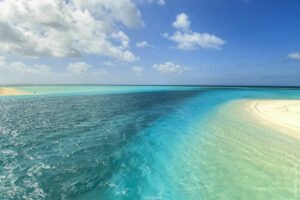
The Mediterranean accounts for less than 1% of the world’s ocean surface, yet it is home to up to 18% of known marine species2, while the region is warming around 20% faster than the global average3. In New Caledonia, the lagoons and barrier reefs form one of the three largest reef systems on the planet, with an exceptional diversity of corals and fish4. WeSea aims to strengthen marine biodiversity literacy, as part of the broader Ocean Literacy movement.
Our objective is not simply to provide more information.
It is about giving environmental facilitators, educators, parents and other adult role models the words, concepts, connections and resources they need to identify the factors at play, understand what is happening and why it matters, determine where they can take action, and help spread this understanding within families and communities. In line with the European GreenComp framework5, this means developing systems thinking and critical thinking, but also individual initiative, collective action and the capacity to act for sustainability. WeSea will bring together the knowledge and experience of its partners, marine biologists, biodiversity specialists, environmental educators and their networks to identify, connect, test and share the most useful existing practices and resources, with particular attention to people facing barriers to accessing environmental education.
Selected for funding under the Erasmus+ Small-scale Partnerships in Adult Education programme, WeSea can now move from ambition to action. European support makes it possible to connect expertise across the Mediterranean and the South Pacific, bring knowledge closer to the communities concerned, and place practical resources in the hands of those already working to understand and protect marine ecosystems.
Together with CIE, CRAM and DYKD, we are launching this cooperation with the ambition of contributing together to making marine biodiversity more visible, more understandable and more capable of inspiring action.
WeSea is co-funded by the European Union through the Erasmus+ programme.
- UNESCO-IOC, Ocean Literacy for All: A Toolkit, 2017. ↩︎
- UNEP/MAP & Plan Bleu, State of the Environment and Development in the Mediterranean, 2020. ↩︎
- WWF Mediterranean Marine Initiative, The Climate Change Effect in the Mediterranean: Six Stories from an Overheating Sea, 2021. ↩︎
- UNESCO World Heritage Centre, Lagoons of New Caledonia: Reef Diversity and Associated Ecosystems. ↩︎
- European Commission, Joint Research Centre, GreenComp: The European Sustainability Competence Framework, 2022. ↩︎